We are reprinting Jeff Davis’s conversation with Matt Kane, originally published on December 2nd, 2021. —Eds.
- test
- aaaa
- 111111
- 22222
- aaaa
heading 1
heading 2
heading 3
heading 4
Matt Kane is an artist who explores historical aesthetics with code, doing with geometry what the great painters did with oils. He left the art world for a decade to work as a web developer in the Pacific Northwest. It was there that he taught himself programming, gained life experience, and made career choices centered around creating the work that he is currently devoted to. Kane began as a painter of oils to become a painter of code.
this is some code“The generative process forces me to consider the world in novel ways, such as viewing a tree’s branching system or the form of a rock through the lens of an algorithmic method.” —DCA
Jeff Davis: Hi Matt! It’s great to have an opportunity to get to know you better. When would you say you first started making art?
Matt Kane: As a child I always loved drawing. In elementary school we had no formal art classes, but I gained the reputation of being “the artist” every year. I was always drawing in the margins of all my papers. Other kids would sometimes challenge me to drawing contests—basically things like who could draw Homer Simpson better. Honestly, there were a couple times I wasn’t the best and my title of “the artist” was put in jeopardy! Later in high school I had what I think are the world’s greatest art teachers. They really brought me under their wings and opened me up to what art was and got me thinking about what art could become. That’s where the most important part of my formal education in art happened and where I learned how to present myself professionally. I entered high school wanting to become a cartoonist or an animator, maybe an illustrator when I grew up. But far from these commercial careers, I graduated with Willem de Kooning as my art hero. Those teachers supporting and nourishing my passion had me convinced by the time I graduated that art was where I could dedicate the rest of my life.
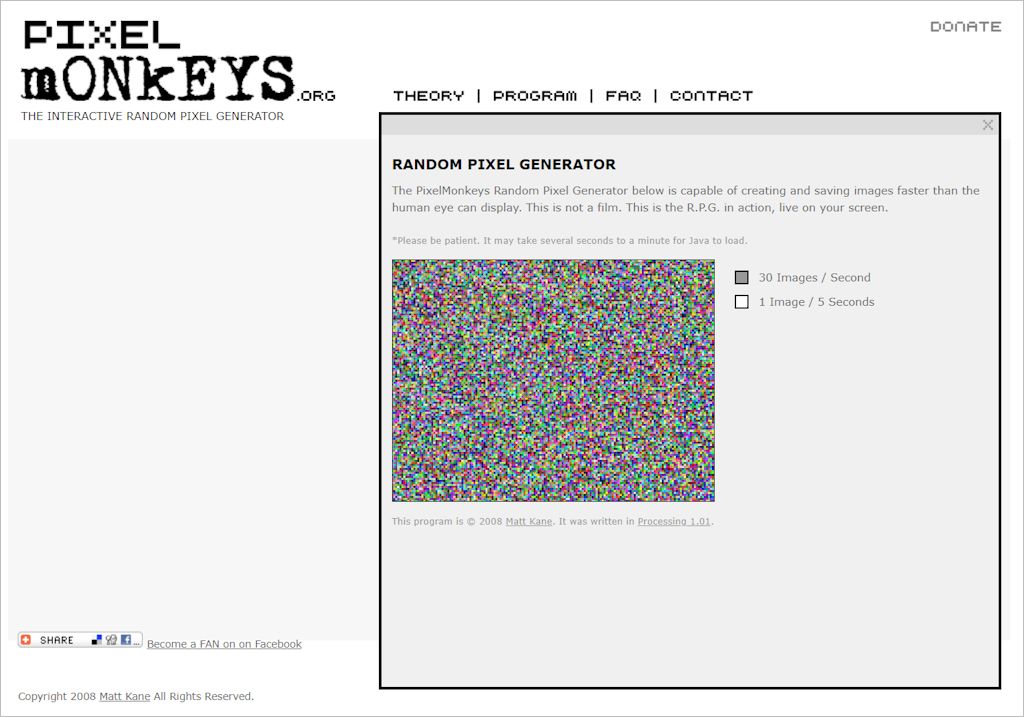
Matt Kane, PixelMonkeys.org, 2008. Live view.
JD: And then when did you start pursuing generative art?
MK: Funny story. When I was about ten years old, I played Nintendo games. Do you know Ninja Gaiden? It had the best, most realistic cut-scene graphics of any 8-bit game back then. For a kid, it was like looking at photos or pages from a comic book. I got to thinking about how all these graphics were made up of pixels. That got me thinking about how if different colors were reordered randomly, you could make a computer program that generated every picture that could ever be possible. Most images would be static garbage, but once in a while you’d land on something really profound! I didn’t own a computer then—I was only ten. But fast forward about seventeen years to 2008. I was in web development for probably about a year or two at that point and learned about Processing.org.
So that became my first conceptual, generative project. I went to work making a random pixel generator. I based the thought experiment on the infinite monkey theorem where if you have a monkey hitting keys on a typewriter into infinity, you’d eventually create the complete works of William Shakespeare. So the same idea except pixels and images instead of letters and words. So that’s how Pixel Monkeys got created. And then recently I found out that Mario Klingemann, probably in the 1980s, entered into generative art with pretty much the same “every image” thought experiment. It’s interesting how many people stumbled on this website and emailed me over the years telling me about how they thought about this same thing. I’ve always seen neural networks and GANs as being the next step in that evolution toward the “every image.” It’s very different from where I am now with my work, but an important step along the way. So I messed with Processing a little bit on and off the next six years before seriously beginning an everyday ritual of making a generative sketch and building the Digital Art Studio Software I began in early 2014.